For much of my career, I believed I was working my way towards a profession in which my values and my work would finally become one. My career journey has by no means been a linear one. Over the past fifteen years, I moved from quality management, auditing, health and safety, fire safety and eventually to my current role in sustainability.
When you look at it on paper, the roles would seem different to you, but when you look deeper, you will see that the core principle applies to all of them. For example, fire safety is about protecting people, property and environment. Quality and auditing are fundamentally about evidence, accountability and doing what a company or organisation says it would do whilst health and safety is all about proactively preventing harm to people instead of reacting after a damage has been done.
When I got into sustainability, it felt like all the experiences I had accrued had finally converged. It felt so because to me sustainability was all about the welfare of people, the future of our planet and the responsibility we carry towards future generations. In spite of my experience, I understood how much more I needed to continually learn, particularly as I realised that as a sustainability professional, you are automatically expected to have an idea, or know everything, from energy, carbon, biodiversity, compliance, to analysing, reporting and monitoring. So, I continued to study, completed professional developments and pursued postgraduate education. This, I guess, was what I told myself building credibility was all about. In essence, I felt like I did not want merely to work in sustainability, I wanted to be worthy of my profession.
As time progressed, I felt I had found a professional home that was mainly comprised of people that were driven by the same motivation and conviction. I was of the opinion that if any sector was to contain people that are motivated by genuine concern for others, surely, it would be the sustainability profession. The tone and language certainly came across reassuring. Individuals spoke passionately about social value, equality, community, justice and the need to protect those most vulnerable to environmental and economic change. Yet, the more I got involved, the more I realised that there was indeed a lot of virtue signalling, which didn’t sit right with me. This emerged gradually via interactions at conferences, workplace conversations, corporate campaigns, social media posts and the carefully curated images that increasingly seemed to accompany public displays of goodwill.
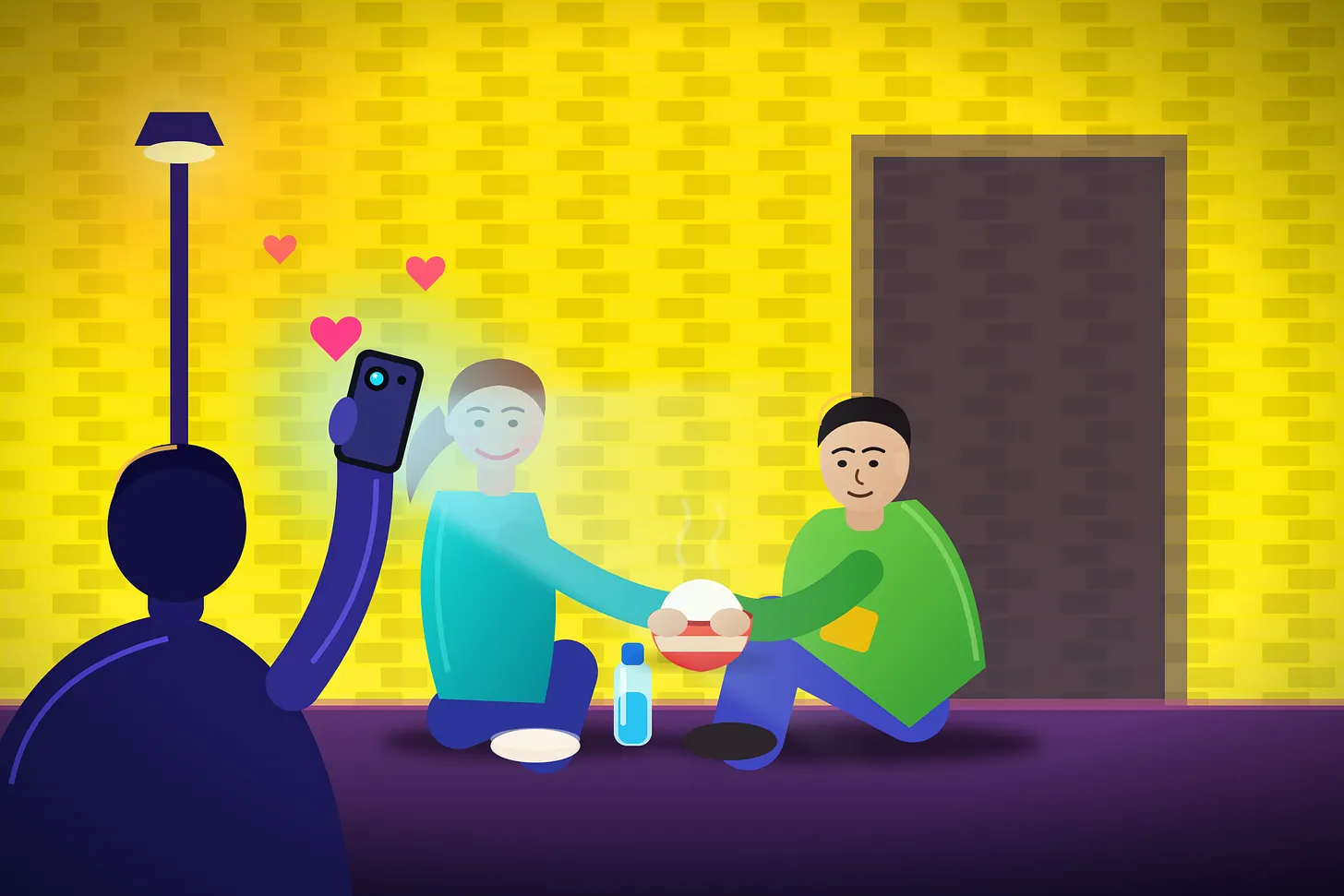
I observed that even though a lot of us used the same language, we were not necessarily motivated by the same objectives. Some people appeared genuinely concerned with creating change, whilst others appeared more concerned with being seen near it. That distinction became increasingly difficult to ignore. I would often see senior leaders pose for photographs with frontline colleagues to demonstrate that they were approachable and connected to “their people”. These images would then appear in newsletters or on social media channels, often accompanied by nice words about teamwork and appreciation. But to me I sometimes wondered what would have happened after the cameras had disappeared. That is, did those frontline workers receive greater recognition, better conditions, or a meaningful voice? Or was it just a case of their presence providing a useful backdrop for someone else’s leadership story?
I will regularly see charitable activities presented in ways that would somehow make the giver more visible than the receivers. Some would publicise charitable trips to “Africa”, as if the entire continent of Africa could be reduced to a single destination that is associated with need. Photos would show the smiling volunteers surrounded by people from the local community, often children, while captions on posts explained how humbling or life-changing the experience was for the volunteer. To me looking at this aesthetically it seemed like the local communities in the photos sometimes appeared less like people with history, dignity, and agency, but more like props in someone else’s moral journey.
Some of things that sometimes appear on my social media timeline included sponsored marathons, charity bike rides and skydives that the person volunteering would portray as acts of sacrifice, even in instances where you can clearly tell it was something the person keenly wanted to experience. In other cases, I will see photos, of those who have visited baby banks, food banks and shelters, released almost immediately after the event, converting moments of service to media content. To me, it wasn’t that the charitable efforts were not commendable, it was the attention-seeking visibility that surrounded the acts of kindness that left me baffled.
To be clear, I am not saying any of these activities are inherently wrong, because volunteering and fundraising matters as much as the associated publicity which can help raise awareness and encourage others to contribute to a cause. I am also not saying anyone that shares about their charity work is motivated by personal branding and of course, a photo does not automatically invalidate a good deed. My discomfort lies in the subtle reallocation of focus from the cause being helped to the ‘compassionate good Samaritan’.
As someone that was brought up with a different understanding of good deeds, helping someone to me was something to be done silently, without bringing embarrassment or obligation to the receiver. In essence, the recipient’s dignity should always matter more than the giver’s recognition and publicising generous acts risked using praise as part of the reward, therefore diluting the main point of the act. That upbringing shaped my instinctive response to public performance of compassion. Whenever the camera seemed too prominent, the donor visible more than the need or the caption too self-congratulatory, I found myself asking who is this was really for?
Considering that what motivates people is not always pure, the answer to me is not a black and white one. Someone can genuinely care about a cause and still enjoy the praise associated with supporting it. An organisation can use charity work or donations to create meaningful benefits and at the same time utilise those benefits to improve its wider reputation. It is therefore pragmatic to say that compassion and self-interest can coexist within the same good deed or action. The problem begins when recognition starts being the objective instead of a by-product.
As time passed, I came to view people that operated in this manner as ‘narcissistic compassionates’, not necessarily because they come across as being consciously deceptive, cynical or cruel, because let’s face it, a lot of them may sincerely believe in the causes they champion. What stood out about them is the extent they would go to make use of other people’s hardship as a stage to promote their own virtue signalling. As such, this type of compassion becomes more about constructing an identity instead of the focus of alleviating suffering or improving the lives of others. It portrays that although the person might be aware, progressive, morally engaged and generous, the good deed would not be complete when the recipient benefits, but rather when the audience notices.
Looking at it more broadly, modern culture encourages this type of behaviour because compassion has become a form of social currency in the sense that publicly supporting the right cause can help improve status, approval and professional credibility. This is apparent, say with organisations that celebrate staff who visibly promote fashionable causes, or with politicians that publicly display empathy via carefully curated public appearances. Another avenue where this is visible is with social media, whereby it converts concerns to what I call measurable reactions, thereby giving people the immediate feedback on the success of their moral character exhibition. The end result is that the impact of caring has become increasingly difficult to identify whilst the display of caring has become unusually more visible.
This matters because genuine compassion asks what will improve a person’s situation, preserve their dignity and create long term benefits while narcissistic compassion sometimes unconsciously asks what an action will communicate about the person or organisation delivering it. Although the priorities may sometimes overlap, one is concerned with appearances, and the other is concerned about impact. To me, narcissistic compassion leans towards a clearer moral territory, flourishes where the correct position has already been socially determined and where demonstrating support doesn’t bring about much personal risk. It is mainly concerned with motions that are visible, easy to communicate and emotionally satisfying. Genuine compassion on the other hand can be inconvenient because it often forces us to question the status quo, confront uncomfortable trade-offs or recognise that a well-intentioned initiative is not working. It can also involve listening to people whose views are not popular, dealing with causes with less attention or continuing to support a cause long after the public interest has shifted elsewhere.
Hence the reason why organisations can celebrate and publicise volunteering days or wellbeing campaigns while failing address damaging workplace cultures or to resolve everyday issues of their lowest paid staffs. It is why sustainability campaigns sometimes produce a lot of noise and photos without addressing impactful improvement to the environment and why political outcry often builds up even if there are no practical solutions in sight. Which leads to the feeling that the performance sometimes creates an illusion of progress and substitutes for progress itself.
This risk of this is prevalent for the sustainability profession I am in, where years of greenwashing already makes people wary of grand declarations and corporate commitments. Where the general public are increasingly becoming cynical of corporate social value compassionate acts and view them as marketing tools. And considering a large percentage of the public already view sustainability as a cause driven by moral superiority, expansive gestures and empty words, instead of practical change, not redressing this balance would give those that already doubt the cause more reasons to dismiss it. Particularly as they don’t always see the quieter work of measuring impact, challenging wasteful practices and improving systems, it would mean that the usual spectacle of say personal publicity would then become the story.
Performative compassion can be profoundly patronising to the people it claims to serve in the sense that the recipients are often reduced to the vulnerable, the less fortunate or the disadvantaged, or the props in someone else’s narrative, whilst the giver assumes the more favourable position of the saviour, and as such resulting in a situation where compassion loses its humility. This clear imbalance creates an unavoidable sense of superiority versus inferiority. This is why I have become more interested in how consistently people live their values rather than how they passionately they describe them. In essence, people’s principles should be more apparent in ordinary moments when there isn’t an audience or reputational benefit and not when they are maybe posting online, standing beside a charity banner or speaking on a panel.
For example, how do they treat the receptionist when nobody is watching? Do they support causes that will not enhance their professional profile? Do they listen to frontline colleagues when there are no photos to be taken? Are they willing to challenge an initiative that is ineffective even if doing so will make them come across as less compassionate? Some of the most caring people I know would probably not describe themselves as compassionates even though they help colleagues without keeping score, support relatives without announcing it and contribute to their local communities without an expectation to be recognised. Because publicity was never part of the purpose, their selfless actions may never become content, which reminds me that compassion is often most credible when it is least self-conscious.
Of course, I am not by any means implying that every good deed should remain secret because publicity has the potential to draw attention, change attitudes and attract funding. Organisations should surely publicise important work, especially where accountability and transparency matter. The answer is not silence, but being sensitive to ensure the focus of the publicity stays centred on the cause.
I guess what I am asking is, are we showcasing the story because it promotes the cause, or because it advances our image? Is the initiative meant to create long term change, or to a brief impressive moment? Are the affected people being represented with agency and dignity, or basically as evidence of our compassion? We might find these questions uncomfortable, but discomfort shouldn’t be perceived as some form of accusation or hostility. To me, genuine compassion should be able to survive scrutiny in the sense that, if an initiative is improving lives, scrutiny should help strengthen it. If a cause is confident in its purpose, there should be no need to use moral pressure to protect its weak ideas from challenge. Compassion becomes weaker when it revolves around popularity, moral status and praise, and more powerful when it combines with humility, evidence and honesty.
Although I entered sustainability with the belief that I had found a space where people’s concern for humanity and the planet would naturally overcome ego, I now understand that no profession is immune from human behaviour. It became apparent that even the language of care for people and planet can be taken over by status, ambition, and a desire to be admired. The realisation has not made me less committed to compassion but has made me more demanding of it. I no longer believe that caring should be measured by the visibility of an act, the emotion of a speech or the enthusiasm of a social media post but by what changes for the person, community or cause at the centre of it.
The most important question is therefore not whether we care. Most people believe they do, and many genuinely do. The question is whether we can reach a point that we care enough to remove ourselves from the centre stage of those good deeds. Because the risk of using compassion to tell the world who we are is that the people we claim to care about become supporting characters in a story that was never truly about them. That may look like compassion, it may sound like compassion, it may even receive applause as compassion, but sometimes it is simply narcissism wearing a charity badge.